
On Using Pictures
Blind contour drawing

The second language we like to use in Nature Journaling is Pictures. When I am leading a Nature Journaling class, I like to introduce something called Blind Contour Drawing. This is a technique that is meant to teach us to connect our pencils with our eyes. It is not about drawing a picture; it is about how to see.
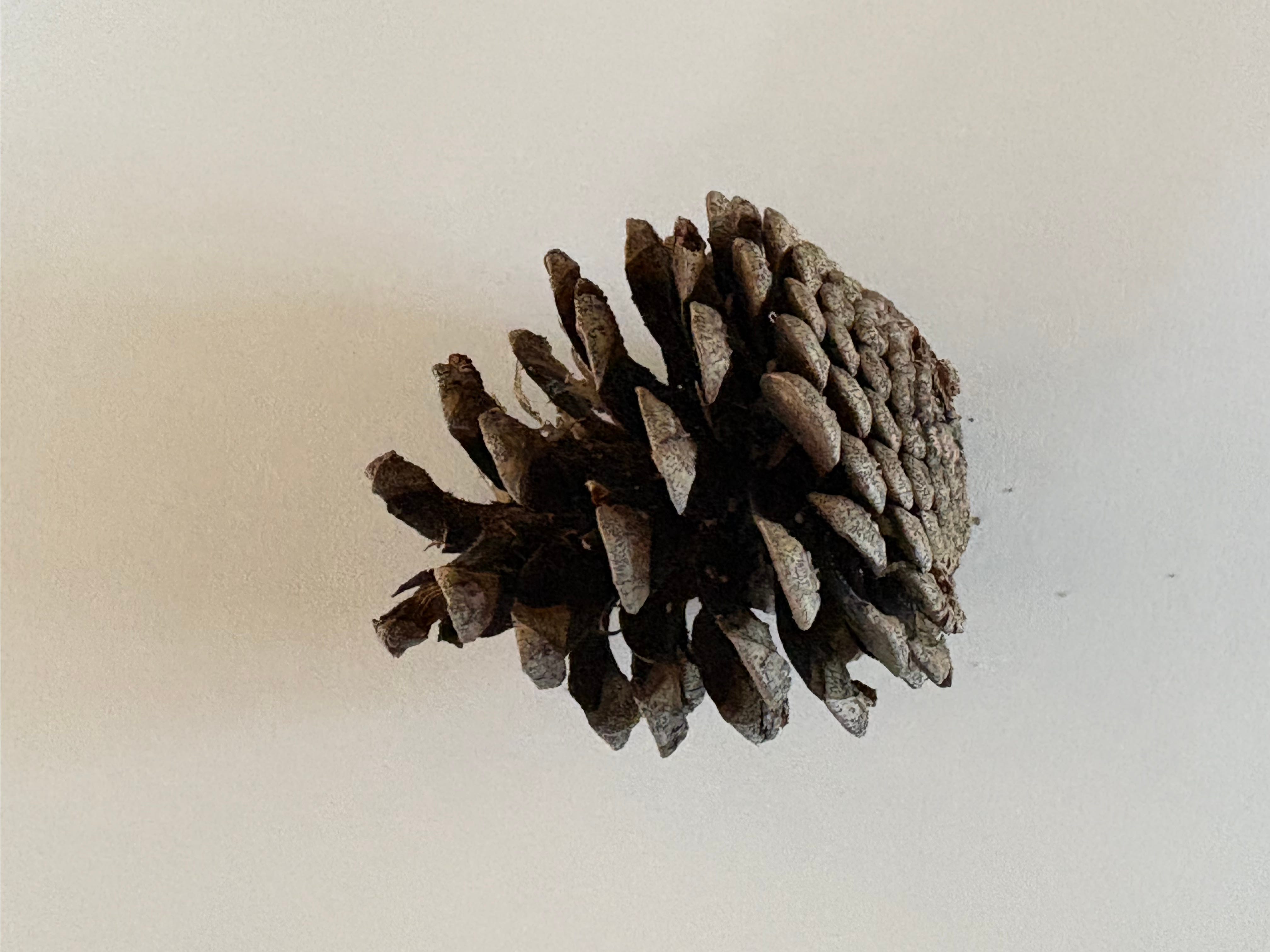
Here is a photograph of a pinecone:
Here is a 25 minute blind contour drawing I did of a pinecone:
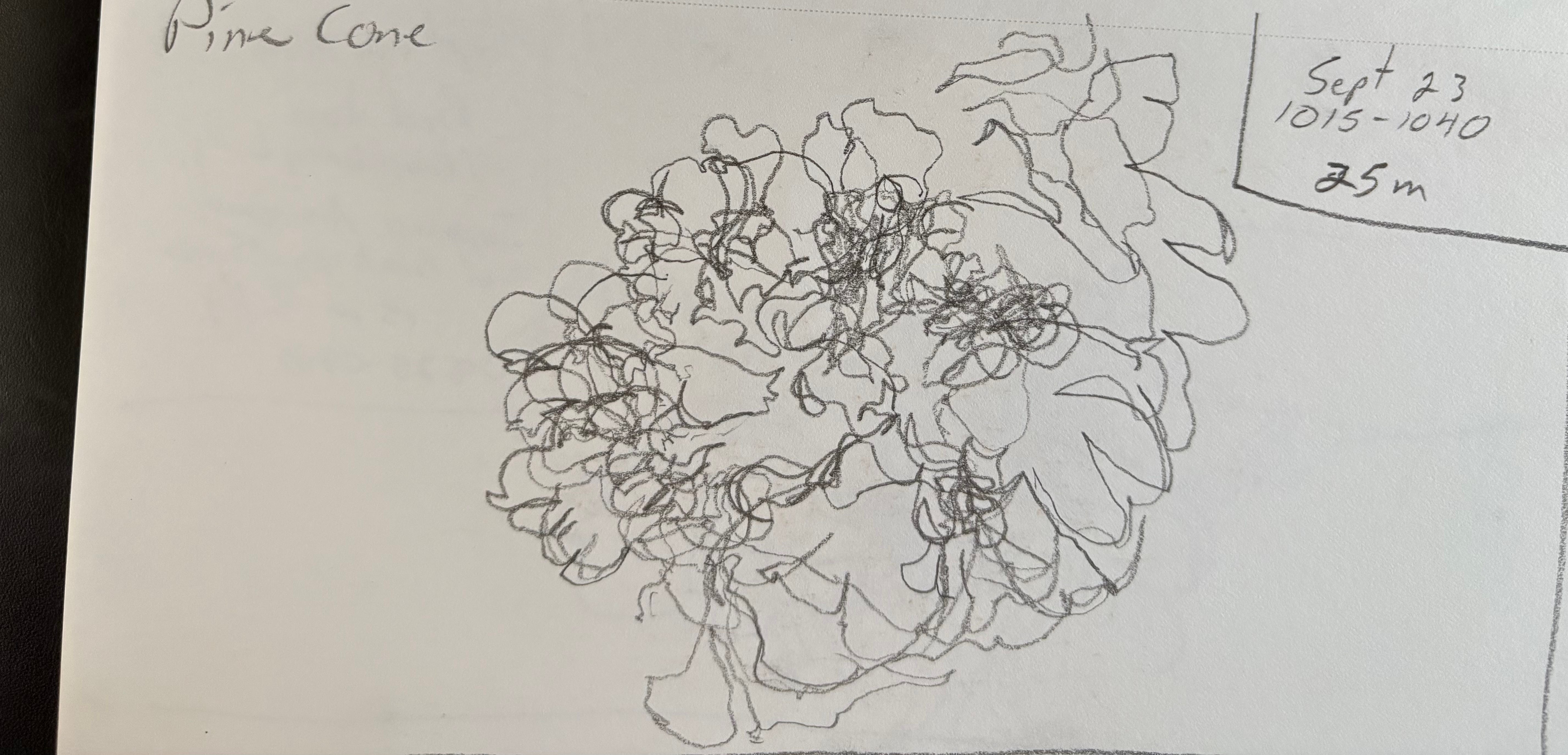
Now, this does not look very much like a pinecone, but maybe, if you squint and use your imagination, you can see a resemblance. It doesn’t matter. The point is that a blind contour drawing is all about the looking, not the drawing. Here is how you do it:
First, get a pinecone. Or something that you want to draw, preferably something from nature. A flower, a seashell, something with a lot of texture and contour. We will wait.
Next, you need a pencil and a piece of paper. Go get it. We are patient.
Now, you have your pencil, your paper, and something interesting to draw. Set a timer for a few minutes. In class I usually go for two minutes on this exercise, but if you are home now and have some time, set it for as long as you want. Now, touch your pencil to the page, and let your eyes rest someplace on your subject. Anywhere that seems like a good starting point. The rules are (1) do not look at the paper, only at the pinecone, and (2) keep your pencil on the page. What you are going to do, for as long as you set your timer, is to let your eyes travel over each contour of the pinecone. Look deeply at each little area where the scales of the pinecone connect to each other, and to the core of the cone, in and out, up and down. Use all of the contours of the cone, not just the outline. As your eyes move around the shape of the cone, move your pencil, as if the two were connected. When your eyes move, your pencil moves.
Start your timer. Don’t look at the paper, just the pinecone. Feel your eyes and pencil move together, and keep moving for as long as your timer runs. You can go over the same line as much as you like, but try to see every little bit of the pinecone, where the line connects from one scale to the next. Keep going until the timer runs out.
Well, what did you end up with? If it looks like a bunch of squiggly lines, you have successfully accomplished your blind contour drawing! If it looks like an outline of a pinecone, you missed the point. Blind contour drawing is all about seeing, not drawing.
So, what good is this in your practice of Nature Journaling? How can you use it?
Nature Journaling is about seeing, making, and collecting observations, not about a pretty picture. If you are out with your journal and are not sure what to do with it, Blind Contour Drawing is one powerful way to get out of your head and onto the page, making observations in nature. Try a few minutes of Blind Contour Drawing, then relax a while. Look again at your subject, and I bet you will see it in a new way. Then you might want to do another drawing of it, but this time look at your paper, and back to your subject, as many times as you want. (This is called Modified Contour Drawing). It works with landscapes, trees, plants, birds; anything you want to draw.
Let me know how it goes.